
GITEX AI Europe 2026: Why AI Needs Digital Accessibility
GITEX AI Europe in Berlin brought together companies, start-ups, and experts from around the world to explore the latest developments in artificial intelligence, digital technologies, and emerging business models. As part of the Austrian Pavilion, WACA – Web Accessibility Certificate was proud to be among the exhibitors.
In addition to Werner Rosenberger's pitch, the event provided countless opportunities for international networking and knowledge exchange. One striking observation was the sheer number of AI solutions and tech start-ups on display. In some cases, several companies presented remarkably similar product ideas—a clear indication of how rapidly this market is evolving.
However, one aspect stood out for a different reason: digital accessibility received very little attention. While AI was a dominant topic throughout the event, the relationship between artificial intelligence and accessibility was rarely discussed.
Yet these two topics are closely connected.

Werner Rosenberger presents the goals of the WACA certification (©️ Advantage Austria Deutschland)
AI Depends on Accessible Information
Traditional website click-through rates continue to decline as more people rely on AI-powered search engines and digital assistants that summarize and interpret information from across the web. For these systems to process content accurately, websites need to be technically well structured and built with accessibility in mind.
Digital accessibility not only improves access for people with disabilities—it also provides the foundation for high-quality machine processing of information. Websites with semantic HTML, clear content, and logical structures benefit both human users and AI systems.
As a result, digital accessibility is becoming an increasingly important quality standard for modern websites and digital services.
Making Accessibility Part of the Process from the Start
For many start-ups, the initial priority is developing a product that works. Accessibility is often considered only at a later stage.
In our experience, the opposite approach delivers far better results.
Organizations that integrate accessibility during the planning, design, and development phases create better user experiences for everyone while saving time, reducing costs, and avoiding expensive retrofits later on. Incorporating accessibility into an existing product is significantly more complex than designing for it from the outset.
That is why Design for All should not be treated as an afterthought but as an integral part of every digital development process.
Our Conclusion
GITEX AI Europe clearly demonstrated the enormous innovation potential of artificial intelligence. At the same time, it highlighted that digital accessibility still deserves a much stronger presence at international technology events.
At WACA – Web Accessibility Certificate, we see this as a clear mission: AI and accessibility should not be viewed as separate disciplines, but as complementary drivers of digital innovation. Only digital solutions that are accessible to everyone and built on high-quality, well-structured information can unlock their full potential.
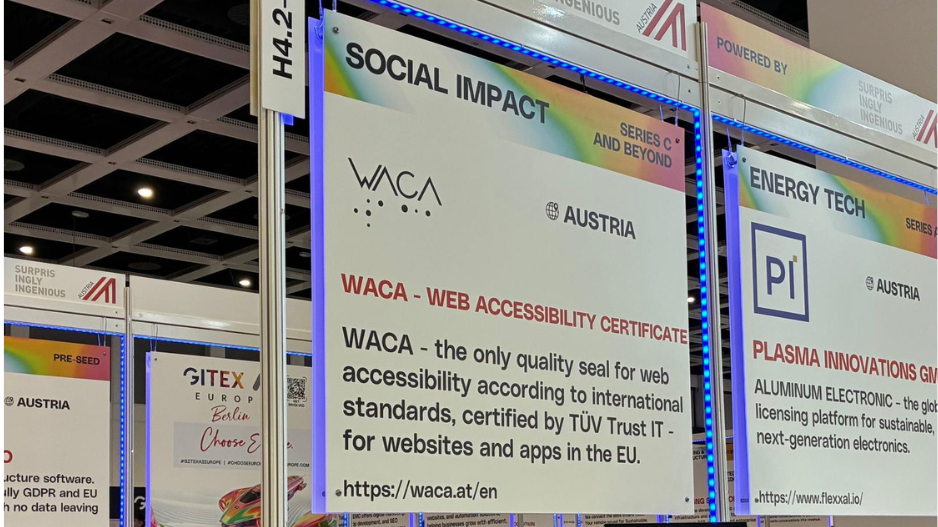
The WACA booth at the Austrian Pavilion